How to Value a Tear-Down in Oakville: Buying Land Rather Than a House, and What That Looks Like in Southeast Oakville
Buying & Selling Petrus Engelbrecht & Joshua Engelbrecht October 8, 2026
Buying & Selling Petrus Engelbrecht & Joshua Engelbrecht October 8, 2026
Price the finished house, not the existing one. How residual land value works, what Oakville zoning allows you to build, and how the arithmetic differs in Old Oakville, Morrison, and Ford
Petrus Engelbrecht & Joshua Engelbrecht | Engelbrecht Associates, Sotheby’s International Realty Canada | Southeast Oakville Specialists
Petrus Engelbrecht and Joshua Engelbrecht of Engelbrecht Associates, Sotheby’s International Realty Canada, specialize in luxury residential real estate across Southeast Oakville, covering Old Oakville, Morrison, and Ford. A tear-down is the one purchase in Oakville real estate where the house on the listing is the least important thing being sold. Buyers still walk through it, count the bedrooms, and compare it to the house down the street. That’s the wrong comparison.
The right way to value a tear-down is to price the house you’ll build, not the one you’ll demolish. You start from what the finished home will be worth, subtract everything it costs to get there, and what’s left is what the land can carry. In Oakville real estate, everything else is detail on that one idea.
A tear-down is valued from the finished house backwards. The existing house is a cost to remove, not an asset to price.
A tear-down is a property bought mainly for its land, where the existing house will be demolished and replaced. The buyer is paying for location, lot size, frontage, and what the zoning allows, not for the structure. A renovation project is different: the buyer is paying for a house that will be kept and improved, so its condition, layout, and bones drive the price.
A dated house on a deep lot can be either. If the existing structure adds nothing to what will eventually stand there, it’s a tear-down, whatever the listing calls it.
The standard method is called residual land valuation. It works as well for a single lot as for a large site. You work backwards from the end value in five steps:
What remains is the residual land value, the most the lot can rationally be worth to someone who intends to build. If the asking price is above it, the arithmetic is telling you either the finished value is higher than you think, the costs are lower, or the price is wrong.
Residual land value in Southeast Oakville is the finished value of the house the zoning allows, minus every cost of getting there. The lot is worth what is left.
The residual calculation tells you what the land is worth to you. Comparable land sales tell you what the market is paying. You need both. On their own, residual numbers are only as good as their assumptions, and a small change in the finished value moves the land value by a large amount, because the costs stay roughly fixed while the end value swings.
That leverage is the single most important thing to understand about tear-down pricing. Construction costs on a given house are much the same whichever street it stands on. The finished value is not. On the strongest streets the spread between the two is wide, which is exactly why those lots attract builders and why they rarely sell cheaply.
Building costs are broadly the same on every street. Finished values are not. That gap is where land value comes from.
This is also why two lots of similar size can price very differently, a point we developed in Lot Size, Frontage, and Land Value in Southeast Oakville. A tear-down valuation is that argument applied with a demolition permit in hand.
The finished value depends on the house you can build, and that depends on zoning. In Oakville the governing document is Zoning By-law 2014-014. For most low-density residential lots south of Dundas Street, which takes in Southeast Oakville, the key controls come through what the by-law calls the -0 suffix zone, designed to keep new houses in scale with established neighbourhoods.
The zoning by-law decides the size of the house, and the size of the house decides the value of the land.
Basements are generally excluded from residential floor area under the by-law, which is why finished lower levels carry so much of the space in new Southeast Oakville homes. Where a design needs more than the by-law allows, the route is a minor variance from the Committee of Adjustment. A variance is a request, not an entitlement, and a valuation that depends on one should be treated as a valuation with a risk attached.
Development charges are worth a specific note. The Town of Oakville applies demolition credits where a building is demolished to permit redevelopment, calculated on the units demolished, and the credit is available for five years from the issue of the demolition permit. Confirm the current position with the Town for any specific property. On heritage, the detail is in Heritage Designation in Ontario, and the wider approvals picture for new construction is in Building New in Morrison and Ford.
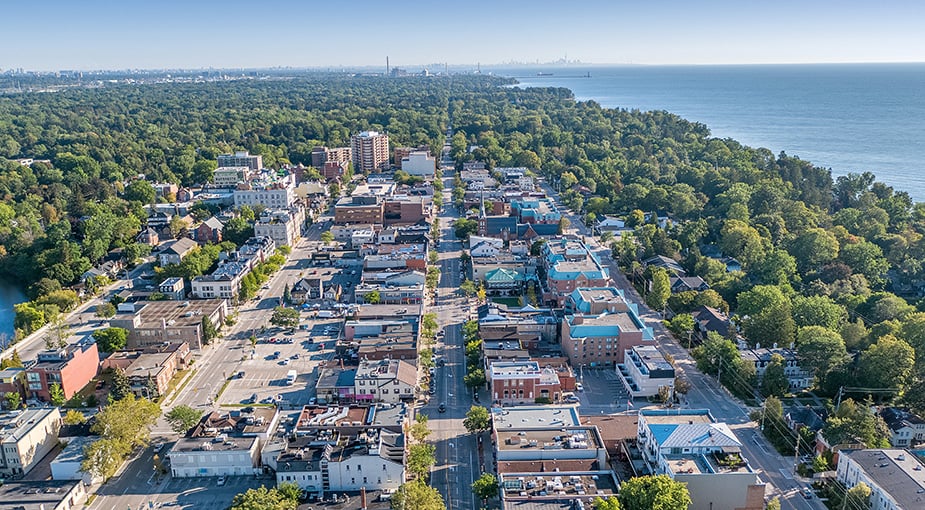
Old Oakville is where the question most often turns out to be the wrong one. Much of the neighbourhood sits inside one of the four heritage conservation districts, where demolition requires a heritage permit and the district guidelines govern what replaces it. Outside the districts, the lots near the lake and the downtown core carry some of the highest finished values in Southeast Oakville, so the residual arithmetic is strong where the rules allow a rebuild at all. The first step on any Old Oakville tear-down is confirming that it can be one.
Morrison is the natural home of the rebuild. Its deeper lots and mature canopy are exactly what buyers of new custom homes want, and finished values on its best streets give the residual calculation room to work. The constraints here are less often heritage and more often trees, grading, and the creek corridors that run through parts of the neighbourhood. Those belong in the cost and time lines from day one.
Ford is where the arithmetic is most sensitive. Its housing stock is younger, built largely between the 1960s and the 1980s, and many of its houses are sound enough to renovate rather than replace. A Ford tear-down works when the finished value on that particular street supports a new build, and the southern lakefront slice of Ford is where that case is strongest. Elsewhere, an honest comparison against a substantial renovation should come before any demolition plan. We describe each neighbourhood in full in Old Oakville vs. Morrison vs. Ford.
A tear-down in Southeast Oakville is a bet on the finished value of one street. The neighbourhood name sets the range. The street decides the answer.
The market conditions we described in our Southeast Oakville Summer 2026 Recap matter here. When sellers are negotiating rather than holding firm, the land component of a price becomes more negotiable too, and a buyer who has done the residual arithmetic is in a far stronger position than one working from the house. A builder’s offer that is anchored to finished value and documented costs is a difficult offer to argue with.
For sellers, the lesson runs the other way. If your house is likely to be bought for its land, market it to the buyers who value land, with the survey, the zoning, and the lot dimensions front and centre. That’s how a tear-down sells for what the land is worth in Oakville real estate rather than what the house is worth.
Start from the finished value of the house you intend to build on that street, then subtract demolition and construction costs, professional and permit costs, financing and carrying costs, and a margin for risk. The result is the residual land value. Check it against recent sales of comparable lots before relying on it.
Not necessarily. A tear-down is priced on its land, and on a strong street the land can carry most of the value of a property. The existing house adds little or nothing to that value and its demolition is a cost.
It depends on the zone and the lot area. Most low-density residential lots south of Dundas Street fall under the -0 suffix zone in Oakville Zoning By-law 2014-014, which limits residential floor area as a percentage of lot area and also controls lot coverage, height, and setbacks. Confirm the zone for the specific lot with the Town of Oakville.
Demolition of a property inside a heritage conservation district requires a heritage permit, and the district plan and guidelines govern what may replace it. Approval should never be assumed before a purchase. Speak to a Town of Oakville heritage planner first.
The Town of Oakville provides demolition credits against development charges where a building is demolished to permit redevelopment, based on the units demolished. The credit is available for five years from the issue of the demolition permit. Confirm the current rules for the specific property with the Town.
Much of Ford was built between the 1960s and the 1980s, and many of its houses are sound enough to renovate. A rebuild makes sense when the finished value on that particular street supports it, so compare the two options on cost, time, and finished value before deciding.
Petrus Engelbrecht
Joshua Engelbrecht
Engelbrecht Associates
Sotheby’s International Realty Canada
Oakville, Ontario
Southeast Oakville Specialists
Sources: Town of Oakville Zoning By-law 2014-014 and its definitions; Town of Oakville Planning report PD-022-14 on the -0 suffix zone; Town of Oakville development charges information; Ontario Heritage Act. Checked 5 October 2026.
This post is general information and general market commentary. It is not legal, planning, tax, or appraisal advice, and not advice on any particular property or transaction. Zoning, development charges, and permit requirements change and vary by lot; confirm the position for any specific property with the Town of Oakville and consult qualified professionals before relying on it. No individual property, transaction, or party is identified.
Stay up to date on the latest real estate trends.

Buying & Selling

Buying & Selling
Why November Remains a Selling Opportunity in Old Oakville, Morrison, and Ford—and How Pricing Determines Late-Autumn Success

Buying & Selling
A Guide to Probate, Executor Responsibilities, Property Valuation, and Selling an Inherited Home in Old Oakville, Morrison, and Ford

Buying & Selling
A Monthly Review of Detached Home Sales, Pricing, Negotiation, and Inventory Across Old Oakville, Morrison, and Ford

Buying & Selling
How the October 2026 Interest Rate Increase Affects Mortgages, Buyer Confidence, and Property Values Across Old Oakville, Morrison, and Ford

Buying & Selling
Understanding Mortgage Appraisals, Financing Requirements, and Lending Risks for Luxury Homes in Old Oakville, Morrison, and Ford
Buying & Selling
Understanding MPAC Assessments, 2026 Property Tax Rates, and How Renovations and Rebuilds Affect Homeowners in Old Oakville, Morrison, and Ford
Buying & Selling
An October 2026 Snapshot of Inventory, New Listing Prices, and Buyer Demand Across Old Oakville, Morrison, and Ford
Buying & Selling
A Buyer's Guide to Pool Inspections, Ravine Restrictions, Tree Protection, and Property Due Diligence in Old Oakville, Morrison, and Ford
With our extensive network, we can assist regardless of where your property journey takes you. It’s about knowing who you are, what you love, and how to make your property journey one that will leave a lasting memory. It’s as simple as that. Contact us today!